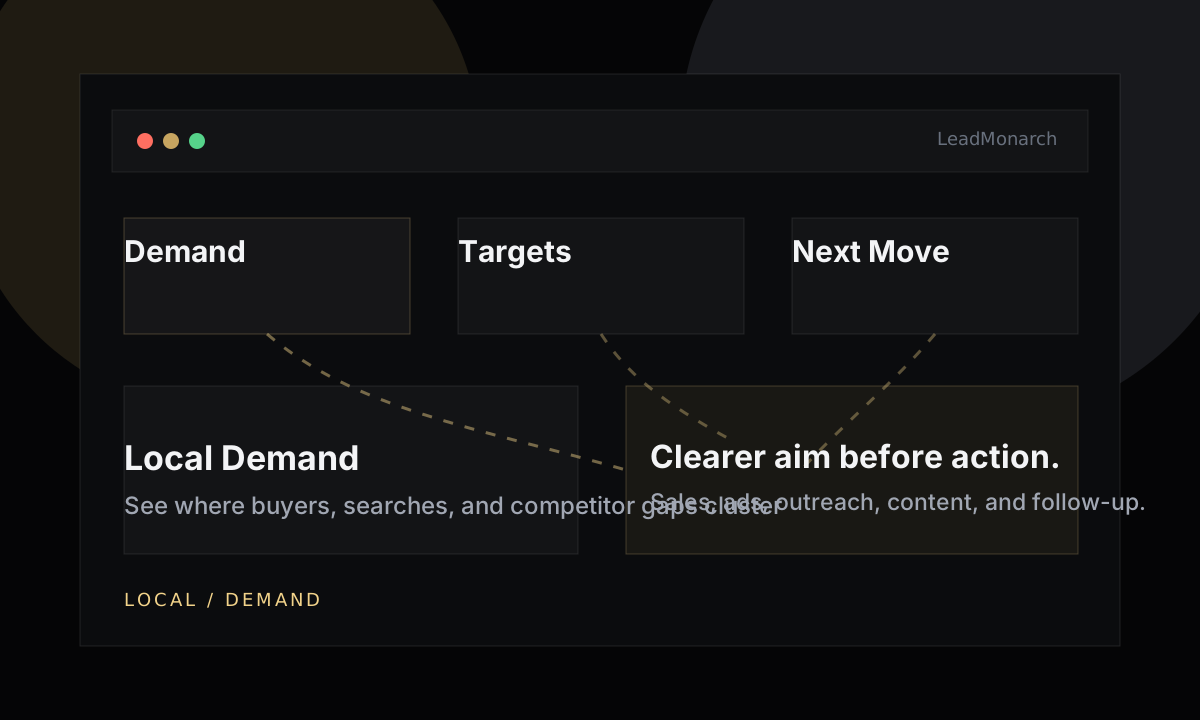
Account growth is not random
Service businesses often talk about their market like it is one big area: the city, the county, the service radius, the metro. But account demand is never evenly spread. A few miles can change urgency, buyer quality, job size, competition, travel time, and close rate.
That matters for B2B SaaS companies, agencies, ecommerce brands, staffing firms, consultants, and other business-service providers. The customer next door may not be the same as the customer across town. One area may produce high-value jobs. Another may create price shoppers. Another may have demand but too many competitors. Another may be underserved but invisible unless you look carefully.
Finding account demand means separating strong zones from noisy zones before you spend money or send your team after them.
Search terms show what people already want
Local search behavior is one of the clearest demand signals. When people search for 'best onboarding software,' 'RevOps consultant,' 'Shopify retention agency,' or 'best staffing agency for warehouse workers,' they are telling the market what they need. Those searches reveal language, urgency, location, and service categories.
A useful account demand system does not just collect keywords. It groups them by intent. Some searches show urgent buying. Some show research. Some show price shopping. Some show broad awareness. Some show commercial value. The difference matters because the ad, landing page, call script, and follow-up should change depending on intent.
If your business does not know which market searches matter, it is easy to create content and ads around the wrong terms.
Maps reveal market structure
Google Maps and local directories show who is visible, who has reviews, who is close to the customer, and which categories dominate an area. For B2B service businesses, map visibility can shape demand as much as the website does.
Look at which competitors rank in each zone. Look at review counts, ratings, service categories, photos, hours, and business descriptions. Look for areas where demand exists but the visible providers are weak, slow, poorly reviewed, or too generic. Those gaps can become sales targets, SEO pages, ad campaigns, partnership ideas, or service-area priorities.
The map is not just a directory. It is a live view of how customers discover local options.
Reviews contain buyer pain
Reviews are a goldmine because customers explain what mattered. They complain about slow response, bad communication, price surprises, poor cleanup, weak results, long wait times, rushed appointments, missed calls, bad scheduling, or lack of professionalism. They also praise speed, clarity, trust, quality, friendliness, and reliability.
A B2B business can use those patterns to find opportunity. If competitors in one area have weak reviews around emergency response, a faster-response offer may work. If SaaS buyers complain about slow implementation, a speed-focused offer may stand out. If commercial service buyers complain about reliability, a proof-heavy sales angle may matter.
The best marketing often comes from real customer frustration hiding in public reviews.
Service-area economics matter
Not every local lead is worth the same. Travel time, job size, crew availability, margins, parking, property type, appointment length, and repeat potential all matter. A zone with many leads but low profit can be worse than a smaller zone with fewer, better opportunities.
This is why account demand should be scored, not just counted. A opportunity map can compare search volume, competitor weakness, customer value, service fit, operational cost, and past results. That creates a more honest picture than 'there are people searching here.'
Good growth systems help the business make money, not just stay busy.
Find targets, not just areas
For some B2B service businesses, account demand means specific accounts. A commercial cleaning company may want office buildings, schools, property managers, or warehouses. A staffing agency may want manufacturers, logistics companies, hotels, or logistics employers. A B2B local provider may want companies matching size, location, and urgency signals.
In that case, the system should discover businesses inside the right zones, enrich them with websites and contacts, score them by fit, and recommend outreach. That turns local research into a call list or campaign plan.
The best account opportunity system can answer both questions: where should we focus and who should we contact?
Use local pages and ads together
Local SEO and paid ads should not be separate guesses. If demand exists in a location, the business may need a service-area page, a localized offer, reviews from nearby customers, map optimization, and an ad campaign pointed at the same market. When those pieces support each other, the business looks more relevant.
For example, if a SaaS or agency buyer segment shows demand around a specific problem, the move may include a targeted landing page, account list, paid test, and follow-up sequence for reachable decision makers. The system should recommend that package instead of leaving the owner to connect the dots.
Account growth works better when research, content, ads, and outreach aim at the same opportunity.
Create a weekly account opportunity review
A practical operating rhythm is simple. Each week, review new demand signals, map changes, competitor movement, new targets, high-priority locations, and recommended actions. Decide what to contact, what to advertise, what content to create, and what to ignore.
This keeps growth from becoming random. The owner no longer has to ask, 'where should we market this week?' with no evidence. The answer comes from a living view of account demand and business fit.
That is the point of a custom account demand system: better aim, every week.
A account demand checklist for B2B service businesses
Start with the services that create the best profit, not just the most calls. Then compare locations by search demand, competitor quality, map visibility, customer value, distance, and operational fit. Add review patterns, property types, business density, and your own closed-job history. The strongest account opportunity is usually where several good signals overlap.
This checklist protects the business from chasing areas that look busy but do not produce good work. It also helps find overlooked pockets where competition is weak but buyer need is real.
Example: turning a demand cluster into action
Imagine a commercial service company notices stronger searches in two nearby cities, weak competitor reviews around response time, and several target businesses in the same industrial area. A weak process would simply say, 'there is demand here.' A stronger process turns that cluster into a campaign.
The next moves might be a location-specific landing page, a call list of businesses in the industrial area, a Google Ads test around the urgent service category, and an outreach angle focused on fast response. That is how account demand research becomes practical execution.
Why B2B content, ads, and sales should share one map
Local SEO teams often build pages around keywords. Ad teams build campaigns around audiences. Sales teams chase lists. When those teams do not share the same map, the business spreads effort across too many directions. A account demand system gives everyone one view of priority markets.
If a location deserves attention, it should influence content, ads, outreach, and follow-up. If a location is low quality, every team should know. Alignment makes a small business look more focused than larger competitors.
Common local targeting mistakes
One mistake is treating every segment inside the target market as equal. Another is chasing search volume without considering job value or competition. Another is ignoring operational cost. A lead that requires too much travel, too much coordination, or too little margin may not be worth the same bid as a closer high-value job.
The best account demand systems are honest about profit. They do not just ask where people are searching. They ask where the business can win and make money.
Questions to ask when comparing local markets
Which areas produce the highest-value customers? Where do people search for the service most often? Where are competitors weak, slow, or poorly reviewed? Which locations are profitable to serve? Where do we already have proof, reviews, photos, or past customers? Which segments or business zones should we avoid?
These questions create a more realistic account growth plan. They help the business stop thinking in one big radius and start thinking in priority zones.
How to start with one account opportunity lane
Choose one profitable service and one promising area. Build a focused view of search terms, map competitors, reviews, target accounts, landing page gaps, and ad potential. Then decide the first moves: content, ads, calls, partnerships, or follow-up with past customers nearby.
Starting with one lane keeps the system useful. A B2B business does not need a perfect citywide model on day one. It needs a sharper first market and a repeatable way to decide the next one.
Frequently asked questions about find account demand
How do I know if this is a targeting problem? If your team is doing the work but the opportunities are weak, inconsistent, low-value, hard to reach, or outside your best-fit customer profile, the issue is probably upstream. Sales execution still matters, but stronger execution cannot fully fix poor aim.
What data should a small business start with? Start with the data you can actually use: closed customers, lost deals, target markets, search terms, competitor pages, reviews, ad performance, CRM notes, and public business information. You do not need a massive data warehouse to make better decisions. You need the right signals organized around the next move.
How often should the system be reviewed? Weekly is usually enough for active growth. A weekly review gives the business time to collect new opportunities, check what happened from the last actions, and decide what sales, ads, outreach, or content move should happen next. Monthly reviews are better than nothing, but they can be too slow when cash flow matters.
Can AI help with B2B business growth? Yes, but only if it is tied to real business rules. AI can summarize pages, classify targets, score opportunities, draft research notes, generate campaign ideas, and explain why a target may matter. It should not replace judgment. It should make the operator faster and better informed.
What is the first step? Pick one offer, one customer type, and one market. Build a simple opportunity view around that lane. Find the targets or locations that show the strongest evidence, write the reason they matter, choose the next action, and track whether the action worked.
The operator's rule
The operator's rule is simple: do not make the next growth move until you can explain the target, the reason, the expected value, and the follow-up path in plain English. If the explanation sounds vague, the business is probably guessing. If the explanation is specific, the team can act with more confidence.
This rule is useful because it cuts through tool noise. It does not matter whether the data came from search, maps, CRM history, paid ads, enrichment, public websites, or manual research. The question is whether the evidence helps the business decide where to aim and what to do next.
That is the standard LeadMonarch AI builds around. The system should not impress the owner with complexity. It should help the business make a sharper move than it would have made without the system.
Bottom line
One more point: the business does not need perfect certainty before acting. It needs enough evidence to make a better decision than yesterday, then a feedback loop that shows whether that decision worked.
B2B service businesses do not need to treat the whole city like one market. Demand leaves clues in search, maps, reviews, competitors, target markets, property types, and CRM history. The businesses that organize those clues can make smarter sales and advertising decisions.
If you want to find account demand and better customers, start by mapping where the signals are strongest, which targets match your offer, and what move should happen next.
Want this built around your business?
If your business already sells a real product or service and needs better direction on who to target next, apply for a LeadMonarch AI Growth Scan or custom opportunity build.
Start the application →